Why Social Enterprises Need to Stop Worrying about Being a ‘Real Business’?
And how they will do better business for it!
Around 8 years into my journey with Social Entrepreneurship I decided to do an MBA, business degree. I did this with the desire to shake feelings of imposter syndrome - feelings that I bet a lot of social entrepreneurs feel.
The truth is, most of us got into this work not because we were interested in business, but because there is a big social issue we care about and business tools seemed a good way to address it.
So why shouldn’t you worry about doing ‘Real Business’?
Because, if you are a socially-driven organisation, businesses are trying to be like you!
Or at least to appear like you.
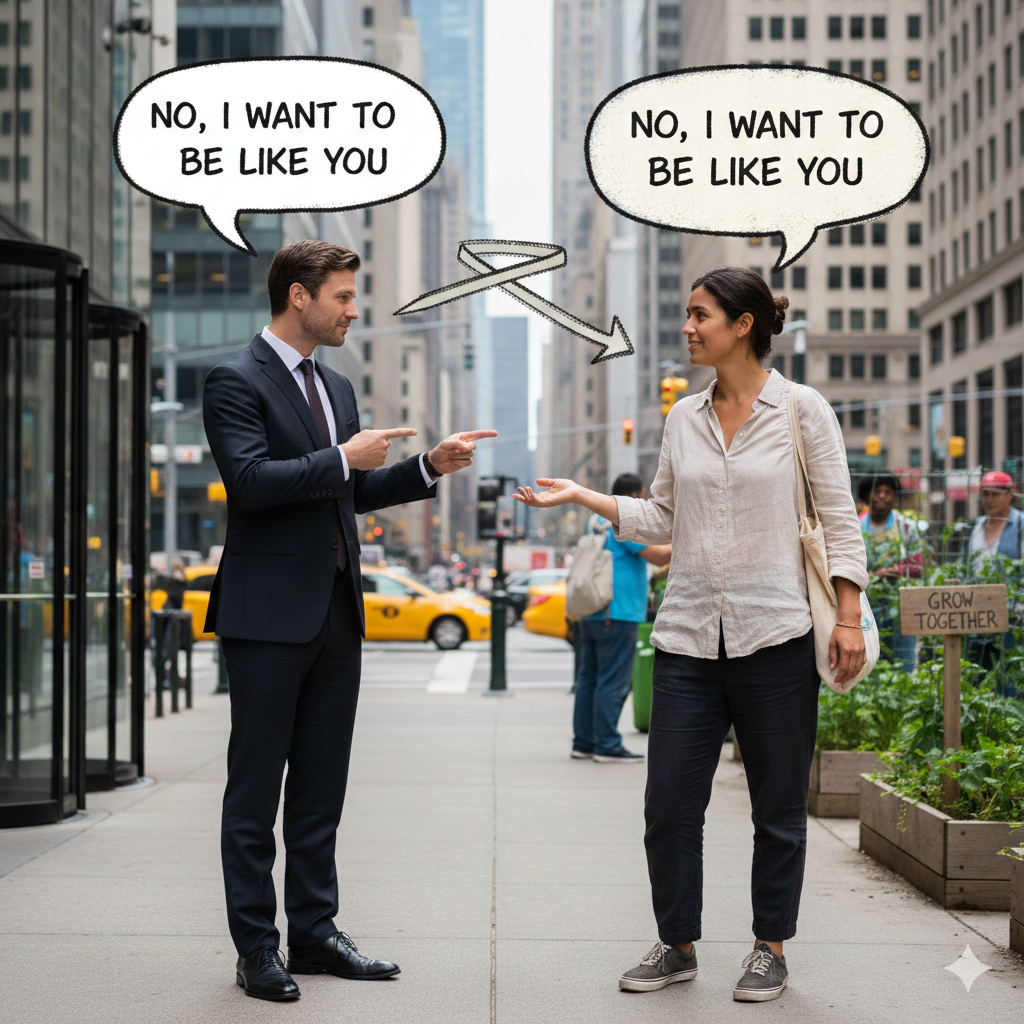
Ai’s impression of a businessman and Social Entrepreneur looking at each other.
Let’s say Social Enterprise has been growing in its current form for around 30 years. In that same period, according to Forbes, Corporate Social Responsibility has rocketed to around $20bn a year by Fortune 500 companies. Even corporations are realising they can no longer define ‘real business’ as only maximizing shareholder profit, but we have been ahead of this curve for a long time.
But CSR is not the same as Social Entrepreneurship! I perhaps hear you say.
Correct, it is not. Why? Because we all know it will be here today and gone tomorrow, depending on the will of shareholders or a political climate.
Why are Social Enterprises different?
Because we are and always have been committed first and foremost to the impact and not to shareholder dividends.
This is exactly why we should be confident in our business acumen as Social Entrepreneurs.
We are not charity workers pretending to do business, we are at the front-line of what ‘good business’ really is in the 21st century.
We can make impact-forward decisions and see them not as a concession to our ‘real-business’ or trying to compete with for-profits on their own terms. Instead, we can see the impact side of our business as our greatest competitive advantage.
For example, a Work Integration Social Enterprise is giving opportunities to people to enter the workforce whose talents and potential has never been released in the workforce. Your skills in unlocking their potential through a compassionate and fair workplace are a huge competitive advantage, as those employees start to contribute new value to your business.
So what did I learn in my MBA about being a ‘real business’?
I learnt that Social Enterprises represent the best of business, and we should not be apologetic about our expertise.
We are some of the most innovative businesses in the world, finding all kinds of workarounds to fund and solve big social problems.
We are some of the most complex businesses in the world, combining trauma-informed workplaces and training programs with daily operations.
We are some of the most well networked businesses in the world, often with supply chains connecting producers in micro-businesses in one part of the world to consumers in another.
Sometimes the imposter syndrome, or the awe of massive buying power in corporations, or the perceived need to show ‘best business practice’ can all get in the way of finding ways to grow our Social Enterprises.
Confident people are the best sales people.
The same is true for Social Enterprises: confident Social Entrepreneurs are the best business people.
So, stop worrying about doing ‘real business’ and start seeing your impact as the key to what doing good business really means. You may then find you start outcompeting the so-called ‘real businesses’!
To get more specific advice to grow your Social Enterprise or socially driven organisation, book a consultation session with Nathanael!